
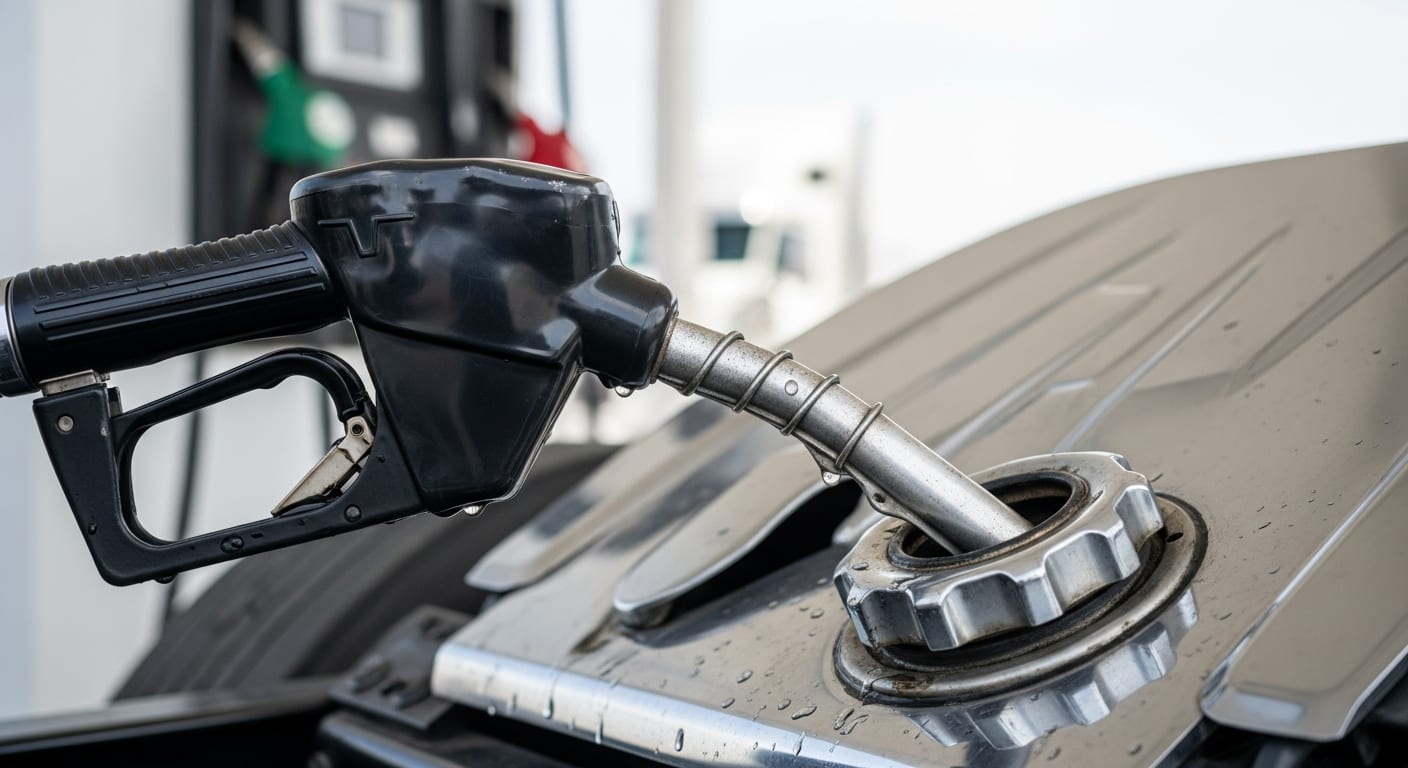
The "Cheapest Pump" Fallacy: Why Your Fuel Strategy is Leaking Cash
Direct Answer
Hunting for the cheapest pump price ignores the true cost of a fuel stop: detour mileage, lost drive time, fuel taxes by state, and contracted discounts elsewhere on the route. The lowest sign price is rarely the cheapest gallon. Fleets that score stops on landed cost (price + detour + tax delta) consistently outperform fleets that chase the sign.
Key Statistics
- A 14-mile detour to a 'cheaper' station can wipe out $0.10/gal of pump-price savings on a typical Class 8 truck.
- State diesel tax differentials between adjacent states routinely exceed $0.20/gal.
- Landed-cost ranking changes the chosen station vs sign-price ranking on roughly half of measured routes.
In the trucking industry, we are conditioned to hunt for the lowest number on the sign. When margins are thin (and they are always thin) saving ten cents a gallon feels like a victory. It feels like responsible management.
But there is a difference between being cheap and being efficient.
If you are directing your drivers to the cheapest station without calculating the cost to get there, you aren't saving money. You are stepping over dollars to pick up dimes.
The "Hidden Tax" of the Detour
Let's break down the anatomy of a bad fuel stop.
The Math Behind a "Cheap" Fuel Stop
Consider this scenario: You find a station offering fuel at $3.50/gallon, while the station right off your route charges $3.60/gallon. The "cheap" station is 15 miles off your route.
Detour distance: 15 miles each way = 30 miles total
Fuel burned on detour: 30 miles ÷ 6.5 MPG = 4.6 gallons
Cost of fuel burned: 4.6 gallons × $3.50 = $16.10
Fill-up amount: 200 gallons
"Savings" at the pump: $0.10 × 200 = $20.00
Actual net savings: $20.00 - $16.10 = $3.90
But wait, we haven't even counted the driver's time yet.
Fuel Burn
A fully loaded Class 8 truck gets 6-7 MPG. Every mile you drive away from your destination is a mile you have to drive back. That's not just fuel. It's wear on tires, brakes, and the engine.
Driver Hours
In an ELD world, time is your most finite resource. Burning 30 minutes for a detour doesn't just cost wages; it eats into the 11-hour drive window. That 30 minutes could be the difference between making a delivery today or sitting at a dock until tomorrow morning.
Opportunity Cost
What else could that truck be doing? Moving freight. Every minute spent on a fuel detour is a minute that truck isn't generating revenue.
The "OptiMile Pro" Approach: Total Cost of Ownership
This is where the human brain struggles and the algorithm excels. A human dispatcher sees "$3.50 vs $3.60." An algorithm sees the entire chessboard.
It calculates:
- The price of fuel.
- The exact fuel burn to reach the station.
- The time penalty of the detour.
- The terrain (uphill detours burn more fuel).
Sometimes, the algorithm will tell you to stop at the more expensive station right off the highway. Why? Because staying on route saves you more in time and burn than you would save at the pump.
Key Insight
The cheapest fuel isn't always the fuel with the lowest price per gallon. The cheapest fuel is the fuel that costs you the least to get into your tank and still arrive on time.
Conclusion
It's time to retire the "Cheapest Pump" strategy. It's a relic of a time when fuel was $1.00 and drivers didn't have electronic logs.
In 2026, the winning fleets don't buy the cheapest fuel. They buy the smartest fuel.
Frequently Asked Questions
Sources
- Weekly On-Highway Diesel Prices, U.S. Energy Information Administration
- An Analysis of the Operational Costs of Trucking, American Transportation Research Institute (ATRI)
- Fuel Surcharge & Truck-Stop Pricing Coverage, Overdrive / Owner-Operator Independent Drivers Association
Ready to Stop Leaking Cash at the Pump?
OptiMile Pro calculates the true cost of every fuel stop, so your drivers always make the smartest choice.
Start Free Trial